
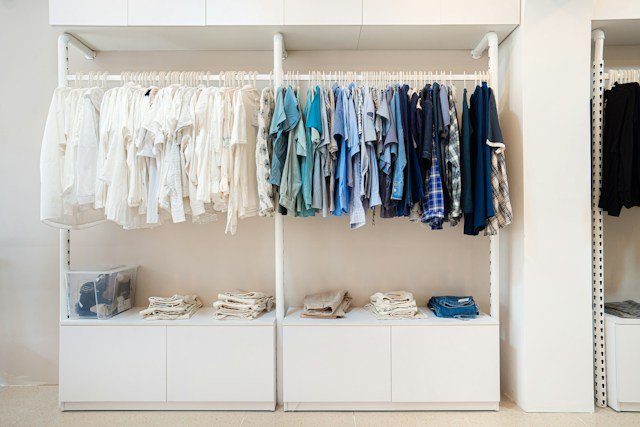
The problem is rarely that you own too much. It is usually that the clothes you wear are hard to reach and the ones you do not are in the way.
Open a small closet on a busy morning and you will see the whole problem at once. A rail so packed that nothing slides. A shelf stacked higher than anyone can safely reach. A heap on the floor that started as one sweater and now has friends. You pull on a shirt, three others fall off their hangers, and you leave for work with the faint feeling that your clothes are working against you.
Small space clothes storage is one of those problems that seems to demand more space and almost never does. People buy another set of drawers, a second rack, a few more hangers, and the room still feels full. The truth is that a small closet or a small bedroom can hold a surprising amount when the clothes are arranged by how you actually use them, and when the space is used from floor to ceiling rather than just at eye level.
This guide is about that approach. It covers how to see your closet as a map of easy and hard-to-reach zones, how to decide whether each type of garment should hang, fold, roll or hook, a one-month test that shows you what you really wear, ways to find extra vertical room, options for rooms with no closet at all, a simple two-box system for seasonal swaps, and some quick fixes for the most common problems. You can try nearly all of it with what you already own.
Why small closets fail, and it is not the size
If you ask people why their closet feels cramped, most will say there is not enough room. But look closer and you will usually see something else. The room is being used badly. The most reachable space holds clothes that are rarely worn. The hardest to reach holds the things that are needed every week. And a great deal of the space is simply air: the gap above the rail, the floor beneath the hanging clothes, the back of the door.
There is also the matter of friction. A garment you can grab in two seconds gets worn. One that is buried under a pile, or that requires moving four other things, tends to get ignored. Over time, a handful of easy-to-reach items end up doing all the work while the rest of the wardrobe sits unused, taking up room. A closet is, in a sense, a ranking of your clothes by how annoying they are to get.
So the aim of good storage is to lower that friction for the things you wear most, and move the rest somewhere out of the way. That is a design problem, not a space problem, and it is one you can solve in an afternoon.
Draw the reach map
Before you move anything, take a moment to look at your storage the way a designer would, as a series of zones. Whatever the size of your closet, the zones are broadly the same. The area between about your shoulders and your knees is the easy zone, where things can be grabbed without bending or stretching. Above and below it are zones that take effort.
A simplified closet. Even in a tiny one, the middle band is the most valuable space you have.
The rule is simple: put what you wear most in the easy zone, put what you wear sometimes in the stretch zone, and put bulky or rarely used items low or in storage. A winter coat in July should not be occupying the prime real estate. Neither should the formal outfit you wear twice a year. The easy zone is for the T-shirt-and-jeans, the work shirts, the cardigans, the things your hand lands on without thinking.
Take everything out and put it back according to this map. It is a satisfying and surprisingly quick job, and it often reveals how much of your closet has been working against you. You may also notice that the easy zone is smaller than you thought, which is a useful reminder of how much you are actually wearing at any one time.
Hang, fold, roll or hook?
Once you know where things go, the next question is how. Different garments behave differently, and the wrong method wastes space or damages fabric. Here is a rough guide to which method suits which kind of clothing, with the best choice marked by a large dot and a workable alternative by a small one.
| Garment | Hang | Fold | Roll | Hook |
|---|---|---|---|---|
| Shirts and blouses | ● | ● | ||
| T-shirts | ● | ● | ||
| Jeans and trousers | ● | ● | ● | |
| Knitwear | ● | |||
| Dresses and coats | ● | ● | ||
| Underwear and socks | ● | ● | ||
| Scarves, belts, bags | ● | ● |
Large dot: usually the best fit. Small dot: also works. Your own fabrics and habits may point elsewhere.
Hang
Best for items that wrinkle or lose shape, such as shirts, dresses and coats. Use slim, matching hangers to gain surprising amounts of room.
Fold
Best for knitwear and sturdy items. File-fold them upright in drawers or on shelves, so you can see every piece at a glance.
Roll
Handy for T-shirts, soft trousers and small items. Rolls fit neatly into baskets, boxes and awkward gaps, and show their contents from above.
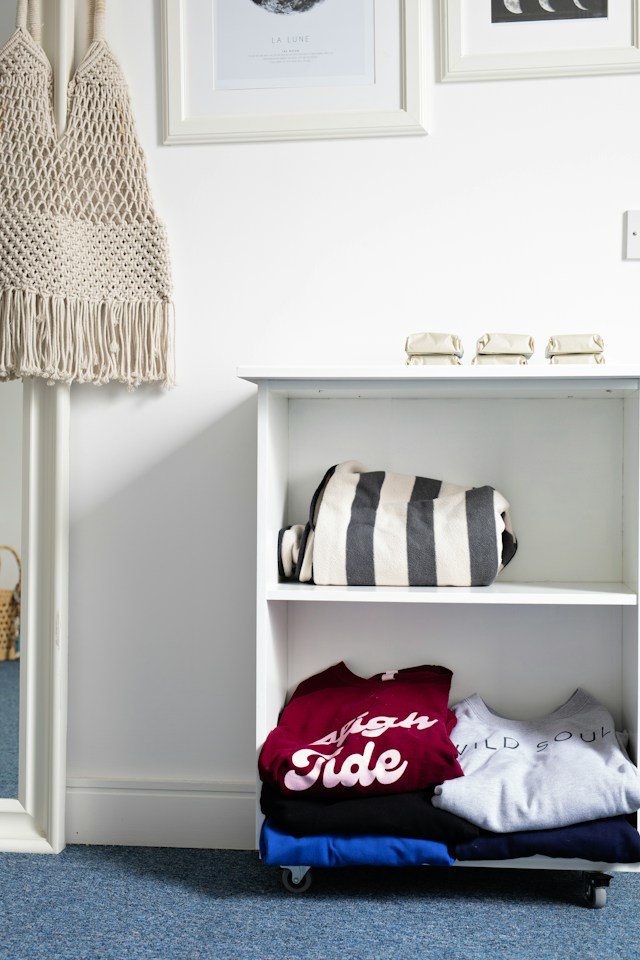
The one-month hanger test
Most of us believe we wear much more of our wardrobe than we do. There is an easy way to see the truth, and it needs nothing more than a month and a little patience.
Turn the hangers around
Hang everything on the rail with the hooks facing the same direction, say toward you. Whenever you wear something and put it back, hang it with the hook facing the other way. After a month, look at the rail. Everything still facing the original way has not been worn.
This is not an order to throw things out. It is simply information. You may find a pile of items you forgot you owned, or ones you keep for a special occasion. Move the unworn ones to the stretch zone or a storage box, and give the easy zone to the clothes you really use.
For folded clothes, a similar test works. Put a small sticky note on the back of the pile and note the date. After a few weeks, notice which stack has barely moved. Those are candidates for the top shelf, a box or a donation bag. The point is to let your actual behavior decide what deserves the best space, rather than your intentions.
Find the room you are not using
Even a small closet has more usable space than it looks. Most of it is vertical. The area above the rail, below the hanging clothes and on the back of the door is often empty, or filled with things that could be elsewhere.
Double up the rail
If your clothes are mostly short, such as shirts, jackets and folded trousers, a second rail below the first can double your hanging space. A hanging rod hung from the first, or a simple adjustable tension bar, works without drilling. Check the weight limit, and keep the heavier items on the upper rail.
Use the shelf properly
A high shelf is perfect for things you reach for seasonally. Use matching boxes or baskets with labels so that you can tell what is inside without taking them down. Shelf dividers keep stacks of sweaters and jeans from collapsing, and they stop that familiar domino effect when you pull one thing from the middle.
Claim the back of the door
Over-the-door hooks and slim hanging organizers can hold scarves, belts, bags, hats and even folded tops. The back of a bedroom door is some of the most underused space in a small home. If you rent, look for options that hook over the top and do not need any screws.
Look at the floor
A low zone can hold shoe racks, stackable bins and baskets. Slim pull-out drawers fit beneath hanging clothes. Keep the floor from filling with loose items, though. Once it does, it quickly begins to feel as if the closet is overflowing, even if the shelves are half empty.
When there is no closet at all
Many small apartments, older homes and rented rooms have tiny closets or none. That does not mean the clothes need to live in boxes. It does mean thinking of clothing storage as furniture, and choosing pieces that look good in the room as well as hold things.
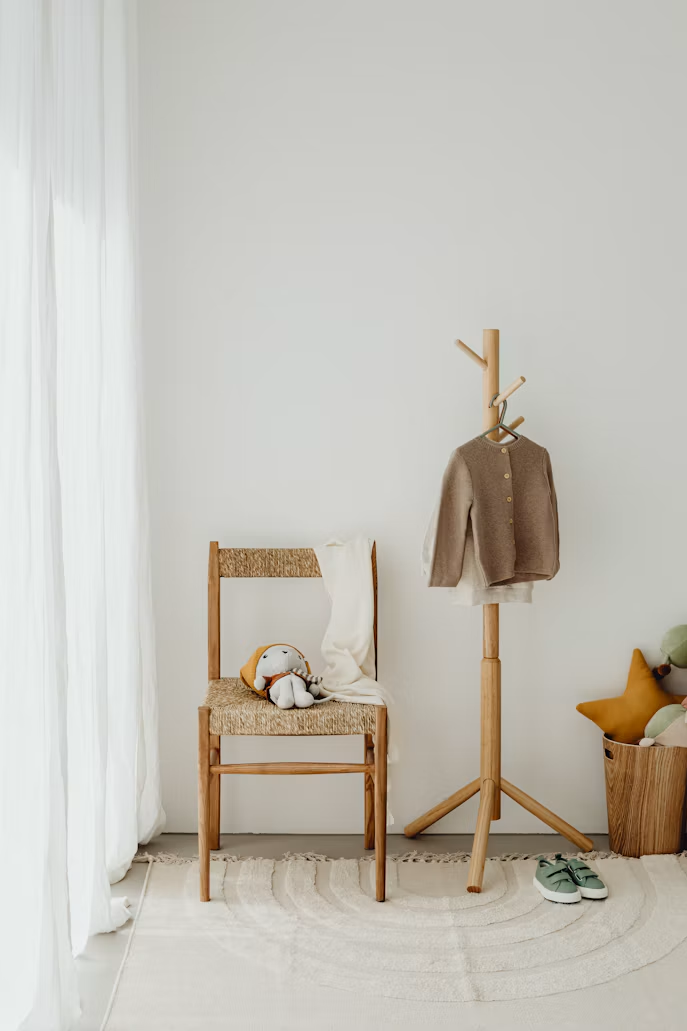
A freestanding clothing rail along a wall can look elegant if the clothes on it are limited and tidy. Think of it as a display, not a dumping ground. Pair it with a low chest of drawers or a set of baskets for folded items, and a few hooks for things you wear repeatedly. A tall, narrow wardrobe can hold a lot in a small footprint, and a headboard with built-in shelves keeps a few things close at hand.
Under the bed is another valuable zone. Low, flat boxes on wheels or lidded containers can hold off-season clothes, spare bedding and bulky items. Make sure the boxes are clean, labeled and easy to pull out, otherwise they become a forgotten corner. If you also want ideas for arranging a one-room home, our guide to studio apartment minimalist design covers zones in a single room, and the post on organizing a small apartment looks at sorting before storing.
Color, order and the calm look
How a closet looks has a real effect on how easy it is to use. A rail of clothes in random order is hard to read, and every morning becomes a small search. A rail sorted by type, and then by color within each type, is far quicker to scan. You see your whole wardrobe at a glance, and you notice gaps and duplicates you would otherwise miss.
A common order that works for many people is to group by category first, such as tops, trousers, dresses and outerwear, then arrange each group from light to dark or from short sleeves to long. The exact system matters less than having one. When something comes back from the wash, you know exactly where it goes, and the closet stays readable without effort.
Uniform containers help too. Mixed baskets in different shapes and colors look busy even when they are tidy. A set of matching boxes or bins, in a calm neutral tone, makes a shelf look composed, and it makes it easier to keep adding and removing items without the whole arrangement falling apart. If you like, add small labels so that anyone in the home can find what they need and put it back.
Finally, light makes a difference. A dark closet is a frustrating one, and things you cannot see are things you do not wear. A small battery-powered light, a light-colored back wall or a bulb that fits the space can transform how a closet feels. Even leaving the door open for a few minutes while you choose your clothes lets daylight in and helps you see colors accurately.
Shoes, bags and the small stuff
It is often the small things that mess up an otherwise tidy closet. Shoes pile up at the bottom, bags hang from every available hook and belts and scarves find their way into drawers where they tangle. A little structure keeps them in check.
For shoes, keep only the pairs you wear regularly in the easy-to-reach area, with the rest in boxes or a rack. A narrow rack that holds shoes at an angle takes less floor space than a flat one. For bags, stuff them lightly with paper or a small cloth so they keep their shape, and store the ones you do not use often inside each other. Scarves and belts do well on a hanger with loops or a set of hooks on the door.
For jewelry and accessories, a shallow tray, a small box or a wall-mounted organizer keeps pieces visible and untangled. The principle is the same as for clothes: if you can see it, you will use it. If you cannot, it might as well not exist.
The two-box seasonal swap
Many small closets cannot hold a full year’s clothes at once, and they do not need to. A simple swap twice a year can keep the closet manageable. It needs only two boxes, or two bags, and an hour or two on a quiet weekend.
Store the boxes somewhere dry and cool, such as under the bed, on a high shelf or at the back of a cupboard. Label them clearly, and consider listing the contents on the lid, so that you do not have to open everything when you are looking for a specific jumper. The swap is also a natural time to notice what you did not wear last season. If something has sat unworn for a full year, it may be time to let it go.
Keeping it from creeping back
A tidy closet is easy to achieve once and surprisingly hard to maintain. The creeping returns of clutter are usually the result of a few specific habits, and each has a simple fix.
The first is the chair of clothes, the place where worn-but-not-dirty items land at night. Give it a proper home: a hook, an open basket or a hanging rack near the bed. It acts as a landing spot, and it can be reset once a week rather than becoming a permanent pile.
The second is laundry. Clean clothes that sit in a basket for days tend to end up all over the room. Put them away as soon as they are folded, ideally on the same day. A short, regular rhythm is easier than a long, occasional marathon.
The third is the arrival of new items. A simple one-in, one-out habit keeps the total from creeping up. When something new enters the closet, something similar leaves, whether by donation, swapping or recycling. It does not have to be strict. It just has to be a gentle check on growth.
Quick fixes for common closet problems
What this adds up to
Good small space clothes storage is less about buying the right organizers and more about seeing your closet clearly. Treat it as a map of easy and hard zones, put your most-worn clothes where they are easiest to reach, choose hanging, folding or rolling to suit each garment and use every inch of vertical space. If you have no closet, build one from a rail, a few baskets and a bit of imagination. If you run out of room, swap the seasons rather than squeezing in everything at once.
You do not have to do all of it this weekend. Start with the hanger test, or empty one shelf and put things back by zone. Small changes make a visible difference quickly, and you will probably find that the closet was never really too small. It was just organized for a life you no longer lead.
Frequently asked questions
How can I store clothes in a small space without a closet?
Use a freestanding rail, a narrow wardrobe, a chest of drawers, under-bed boxes and wall hooks. Keep the amount on display limited, and store off-season items in labeled boxes.
Is it better to fold or hang clothes in a small closet?
It depends on the garment. Hang shirts, dresses and coats. Fold knitwear and sturdy items. Roll T-shirts and soft items to fit into bins. Using each method where it suits best gives the most space.
How do I make my small closet look bigger?
Use matching hangers, keep the easy zone for what you wear most, remove items you do not use, and keep the floor clear. A calm, consistent look makes any space seem larger.
What is the best way to store off-season clothes?
Clean them first, pack them in labeled boxes or bags and store them somewhere cool and dry, such as under the bed or on a high shelf. Swap them with the current season twice a year.
How many clothes should I keep in a small bedroom?
There is no single number. Keep what you wear and enjoy, in a quantity that fits comfortably in your space with room to see and reach everything. If you cannot, the closet may need an edit.
How can I keep my closet organized long term?
Put laundry away promptly, give worn-once clothes a landing spot, follow a one-in, one-out habit and do a quick reset each season.
Do slim hangers really help?
Yes. Slim, matching hangers take up less space on the rail, stop clothes from sliding and tangling, and give the closet a tidier look.

Written by Rayhan Kobir Rayhan writes practical, calm guides about home, routines and everyday living at LifeWise Journal. This article shares general home-organization ideas, not professional design, construction or safety advice. Check your lease and follow product weight limits before installing anything.